
2026 and Beyond
If you run a service business in Australia — a trade, a clinic, an agency, a consultancy — you’ve probably heard that “SEO is dead” more times this year than ever before. AI Overviews, ChatGPT, Perplexity, Claude. It’s a lot of noise.
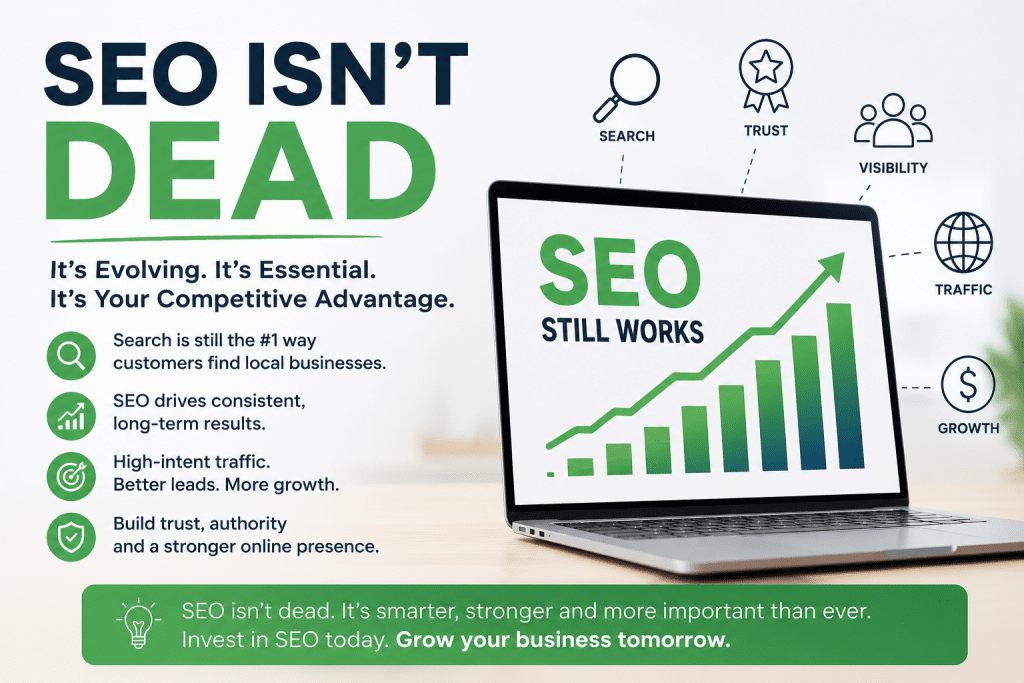
Here’s the short version: SEO isn’t dying. It’s splitting into two very different battlegrounds, and the good news is that the one you depend on is still very winnable.
Search is splitting into two fronts
Not all searches are being swallowed by AI in the same way. Google’s own data on trigger rates shows a huge gap depending on intent:
- Informational queries (“what causes lower back pain”) trigger AI Overviews 80–88% of the time, depending on the industry
- Commercial queries (“best physio Melbourne”) trigger them only around 8.7% of the time
- Transactional queries (“book physio appointment”) trigger them just 1.76% of the time
- Navigational queries trigger them 1.43% of the time
Translation: the further down the funnel a search sits, the less AI is getting in the way. If your business lives and dies by people who are ready to call, book, or drive somewhere, you’re mostly insulated from the disruption everyone’s panicking about.
Where the pain is real is informational content — blog posts written to rank for generic “what is X” questions. Pew Research tracked nearly 69,000 real searches and found people click through to a website only 8% of the time when an AI summary appears, compared with 15% when it doesn’t. If your content strategy has been built entirely around ranking for broad educational queries, that channel is genuinely shrinking. But for most service businesses, that traffic was rarely converting into customers anyway.
Local search is still the main game — and most competitors are still bad at it
This is the part worth paying attention to. Nearly half of all Google searches carried out in Australia have local intent, and research shows 80% of consumers search for local businesses on a weekly basis. The Google Map Pack — those top three results with the map — still captures around 42% of all clicks on local searches.
Despite that, roughly 58% of businesses still don’t have a coherent local SEO strategy. That’s not a threat, that’s an open door. If your competitors are still running a Google Business Profile they claimed three years ago and forgot about, showing up properly is genuinely still one of the highest-return things you can do.
What’s actually driving local rankings in 2026
According to the Whitespark Local Search Ranking Factors Survey, the weighting for the Map Pack and local organic results breaks down roughly like this:
- Google Business Profile signals — about 32%. This is your single biggest lever: complete categories, accurate hours, a proper service description, regular photo updates, and posts that stay active.
- On-page website signals — about 33%. Suburb-specific service pages, clear internal linking, and content that actually addresses what someone in that area needs — not a generic page with the city name swapped out.
- Link and citation signals — about 24%. Consistent name, address and phone details across directories, plus genuine backlinks from Australian industry bodies, chambers of commerce, and local organisations.
- Review signals — a growing share. Quantity, recency, and how consistently you respond all factor in.
On that last point: 83% of Australians say they rely on Google reviews to judge local businesses, and star rating is both a top-six local ranking factor and — more importantly for your bottom line — the single biggest factor in whether someone actually picks up the phone once they’ve found you. Rankings get you seen. Reviews get you chosen.
Suburb pages beat one generic services page
For any service-area business — trades, clinics, agencies covering multiple regions — one of the clearest shifts is away from a single “Our Services” page toward dedicated pages built around the service-and-suburb combination customers actually search for. A Sydney plumber ranking well in 2026 typically has separate, genuinely different pages for each suburb they cover, addressing the specific issues and context relevant to that area, rather than duplicating the same template with the city name changed. Thin, copy-pasted location pages tend to get ignored by both Google and by the customer scanning search results.
Where AI visibility does matter
There’s one area where getting cited inside an AI-generated answer is becoming genuinely important, and it’s concentrated in higher-consideration, research-heavy professional services. Adoption of AI search tools is notably higher in what the industry calls YMYL categories — “your money or your life” — with legal queries showing roughly 12x higher AI search adoption, and finance and health both showing close to 3x. If you’re a lawyer, financial adviser, or health practitioner whose clients research heavily before choosing, it’s worth tracking how your brand shows up when people ask ChatGPT, Claude or Google’s AI Mode about your area of expertise. For a tradie or a local clinic focused on same-day or same-week bookings, this is a much lower priority than getting your Google Business Profile right.
What this means for your business, practically
- Treat your Google Business Profile as an actual asset, not a form you filled in once. Full categories, accurate service list, weekly photo or post updates, and fast responses to enquiries all count.
- Build a genuine review pipeline. Ask happy customers systematically rather than hoping it happens organically — recency and consistency both matter, not just star count.
- Write real, distinct content for every suburb or service area you cover, rather than one page trying to rank for everywhere at once.
- Keep your business details identical everywhere — website, GBP, directories, invoices. Inconsistent NAP data quietly undermines everything else you do.
- Don’t chase every AI-search trend at once. If you’re a local, appointment-driven business, AI Overviews barely touch your core search traffic. Put your time into the map pack and reviews before worrying about ChatGPT citations.
The bottom line
For most Australian service businesses, the future of SEO looks a lot like a cleaner, more disciplined version of the present. AI is reshaping how people research broad topics, but it has barely touched the “I need this fixed today” and “who’s the best [service] near me” searches that actually pay the bills. The businesses winning in 2026 aren’t the ones chasing every AI hype cycle — they’re the ones with a complete Google Business Profile, a steady flow of genuine reviews, and real local content, done consistently rather than as a one-off project.
Want help auditing your Google Business Profile or building out suburb-specific pages for your service area? Get in touch with the Digital Insider team.
